
For university music majors, Royal Conservatory candidates, and dedicated audiophiles, preparing for a music history exam presents a unique challenge. The specific pain point for many attempting to master the intricacies of the Baroque, Classical, and Romantic eras is the stark disconnect between textual facts and auditory recognition. Memorizing a composer's birth year or stylistic traits from a dry textbook does not prepare a student for the dreaded "drop-the-needle" listening exam. Classical music is an auditory discipline; the brain needs to instantly link a specific sonic texture or melodic structure to its historical era and creator.
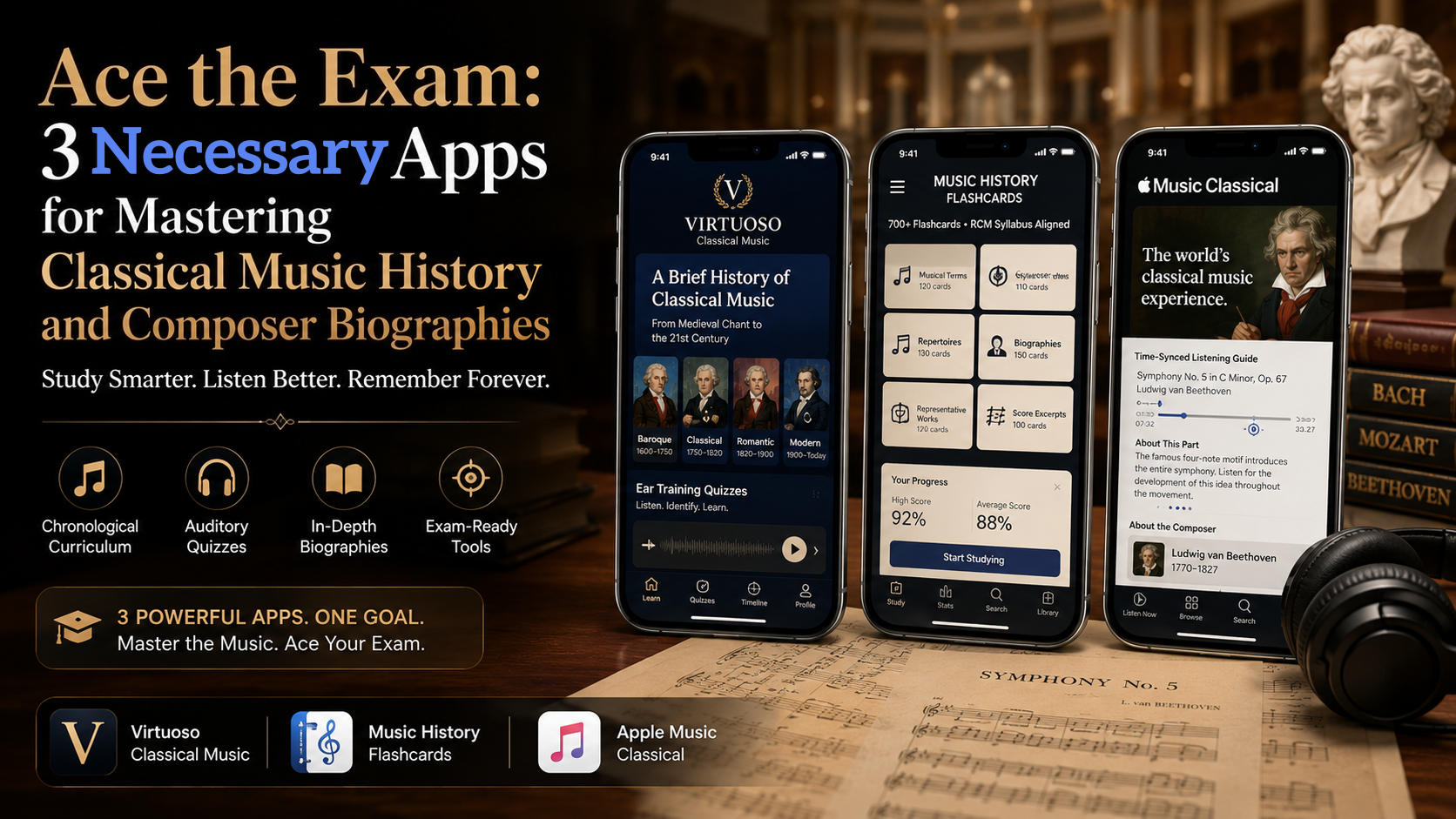
To find the absolute best tools for bridging this gap, tech journalists and music educators spent weeks putting specialized classical music study platforms through a rigorous evaluation process. Reviewers bypassed generic trivia games that lack academic rigor, searching instead for platforms that offer syllabus-aligned curriculums, high-resolution audio quizzes, and detailed biographical metadata.
During intensive testing—where these applications were used to simulate university-level listening exams and drill composer biographies during daily commutes—the evaluation focused on three core benchmarks: chronological curriculum structure, the quality of the auditory testing mechanisms, and historical depth. Here are the three apps that successfully turn a smartphone into a pocket-sized musicology professor.
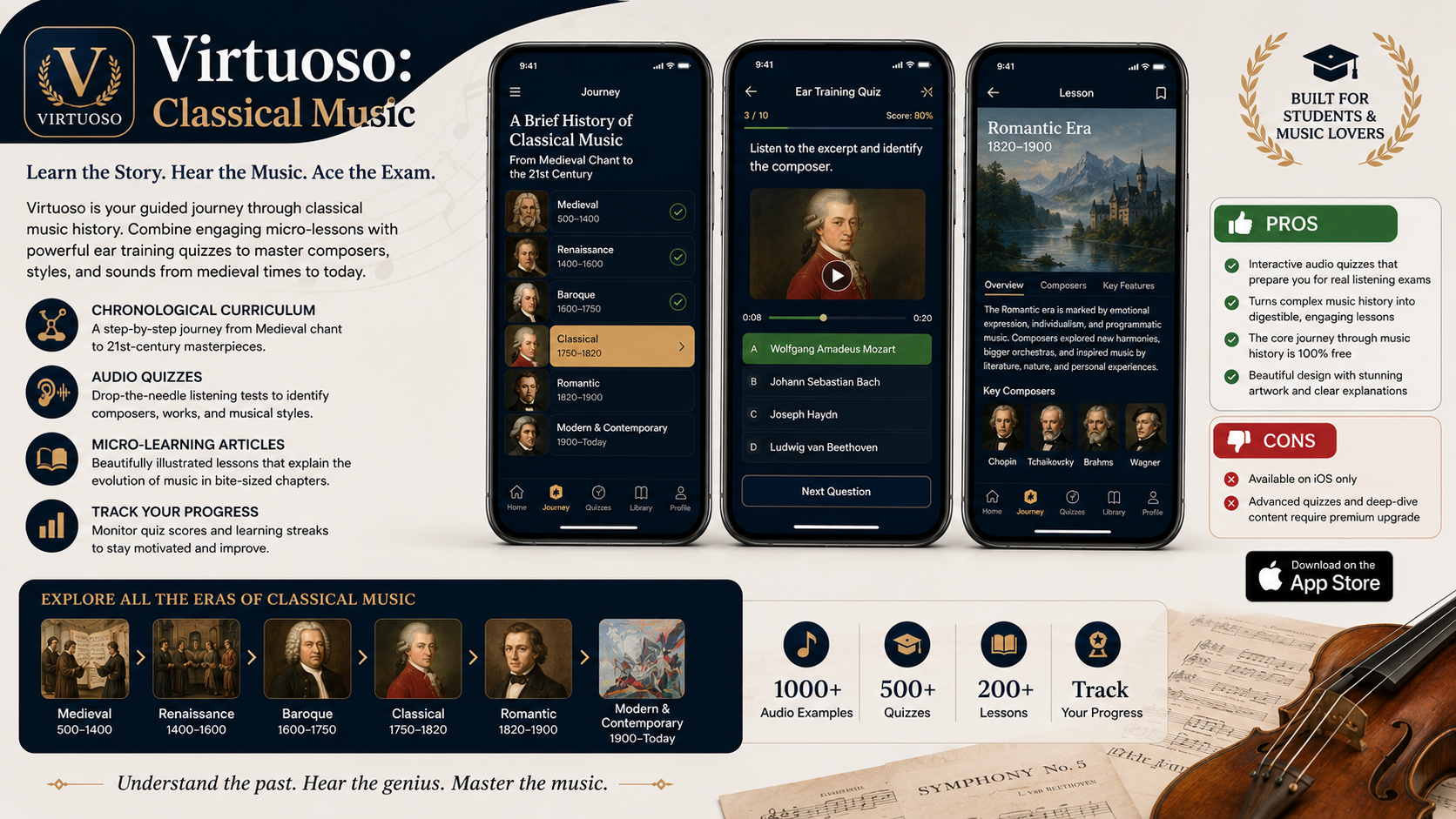
Availability: iOS
Pricing Model: Free basic version; premium content unlocks via in-app purchases or subscription.
Virtuoso sets out to solve the most common problem in classical music education: the sheer, overwhelming volume of information. Instead of functioning as a static encyclopedia, the app is engineered as a guided, chronological path designed specifically for curious minds and exam-prepping students who need to connect the dots between eras.
The core feature that genuinely works is the Tiered Ear Training Quiz System. When reviewers tested this application during simulated study sessions, the app did not just ask text-based trivia. Instead, it played high-quality audio snippets and forced users to differentiate between Mozart and Bach, or to identify specific pieces by Debussy. The app pairs these listening tests with "A Brief History of Classical Music"—a connected series of micro-learning articles that contextualize how the music evolved from medieval chant through the Romantic period. It effectively bridges the gap between reading about a composer's style and actually hearing it in practice.
Pros:
Highly interactive auditory quizzes that directly prepare students for real-world listening exams.
Breaks down massive historical eras into digestible, beautifully illustrated micro-learning articles.
The core chronological "story" of classical music is offered entirely for free, ensuring foundational learning remains accessible.
Cons:
Currently limited to the iOS ecosystem, leaving Android users without access.
Advanced quizzes focusing on complex stylistic nuances and deep-cut historical connections require a premium upgrade.
Availability: iOS
Pricing Model: One-time paid.
Developed by David Powell, Music History Flashcards is an uncompromising, strictly utilitarian academic tool. It is not designed for the casual listener; it is built from the ground up as a study aid for students preparing for rigorous board exams, specifically aligning with the Royal Conservatory of Music (RCM) syllabus for Levels 9 and 10.
The standout feature that delivers incredible utility is the Syllabus-Aligned Categorization. During evaluation, the testing team utilized the app's database of over 700 virtual flashcards, seamlessly filtering them by specific eras (Medieval, Renaissance, Baroque, Classical, Romantic, and Modern). The app drills users on six distinct categories: musical terms, composer styles, specific repertoires, detailed biographies, representative works, and even score excerpts. When testing on the road, reviewers noted that the app acts as a ruthless, highly efficient rote-memorization tool that perfectly replicates the pressure of a formal academic exam.
Pros:
Strictly aligns with formal academic syllabi (like the RCM), making it a direct investment in exam success.
Allows users to isolate their studies by specific eras or categories, perfect for targeting weak points before a test.
Tracks high scores and averages, providing measurable data on a student's memorization progress over time.
Cons:
The interface is incredibly text-heavy and visually utilitarian; it lacks the modern gamification seen in newer educational apps.
Because it is tailored to specific examination boards, it may feel overly rigid for users seeking a casual overview of music history.
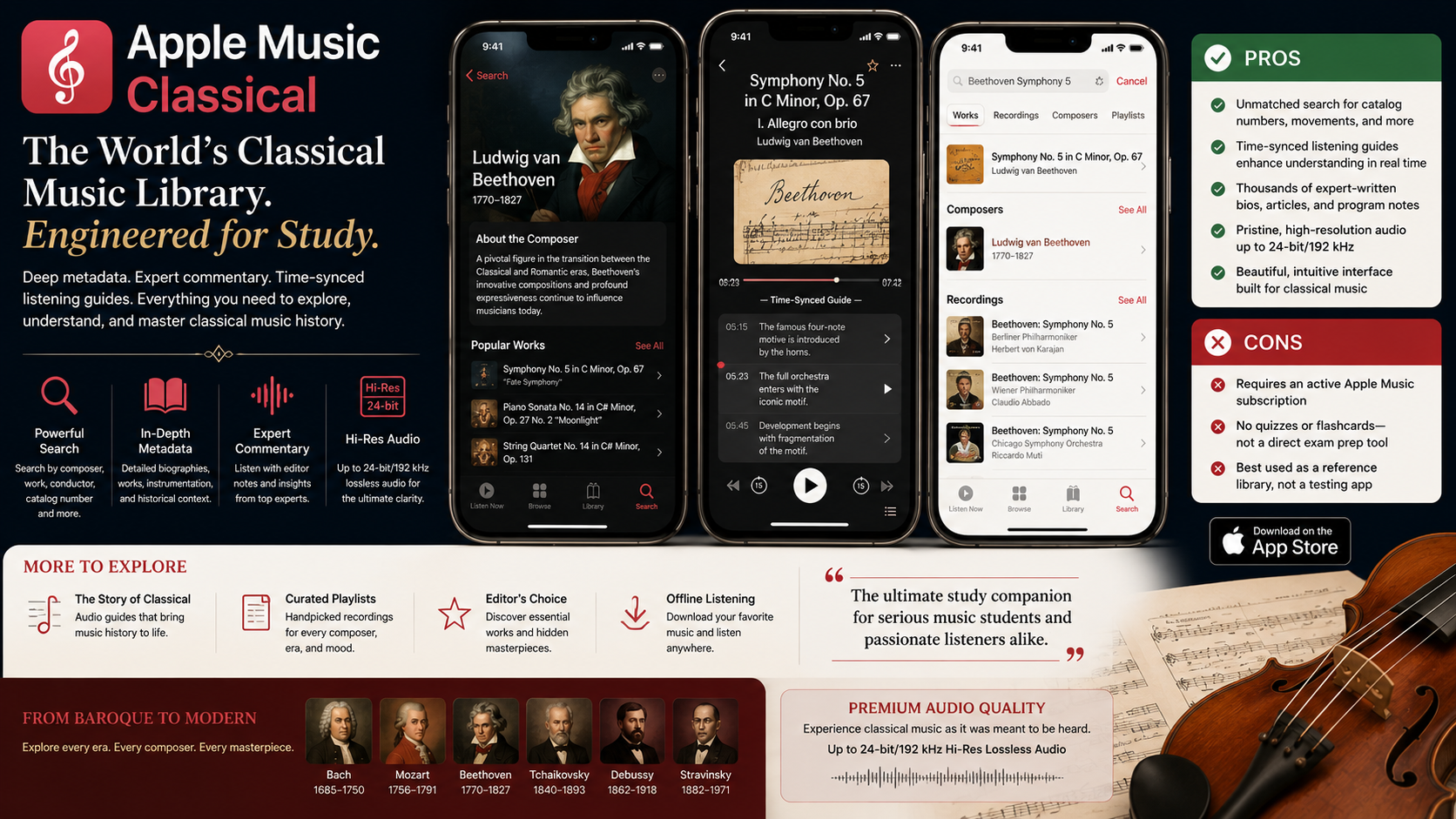
Pricing Model: Free to download (Requires an active Apple Music subscription).
While not explicitly branded as an exam-prep quiz app, Apple Music Classical has quietly become the most powerful reference library for musicology students. Built on the bones of the acquired Primephonic app, it solves the metadata nightmare that plagues standard streaming services, offering a search engine built specifically for classical works.
The engine driving this app's educational value is the combination of Time-Synced Listening Guides and Exhaustive Metadata. When tech journalists tested this platform, the ability to search by composer, conductor, or specific opus and catalog number was flawless. For students studying the evolution of a specific piece, the app provides thousands of in-depth composer biographies and "The Story of Classical" audio guides. Furthermore, the time-synced listening guides act as a digital professor—providing moment-by-moment expert notes from editors right as the climax of a symphony hits. It transforms passive listening into active, directed study.
Pros:
Unmatched search capabilities specifically designed for classical music catalog numbers and distinct movements.
Offers pristine, high-resolution audio (up to 24-bit/192 kHz) which is critical for analyzing complex orchestral arrangements.
In-depth liner notes, expert commentary, and comprehensive composer biographies provide university-level historical context.
Cons:
Requires a paid Apple Music subscription to function; it is completely inaccessible as a standalone free application.
Lacks actual testing, flashcard, or quiz features; students must generate their own study materials using the provided reference data.
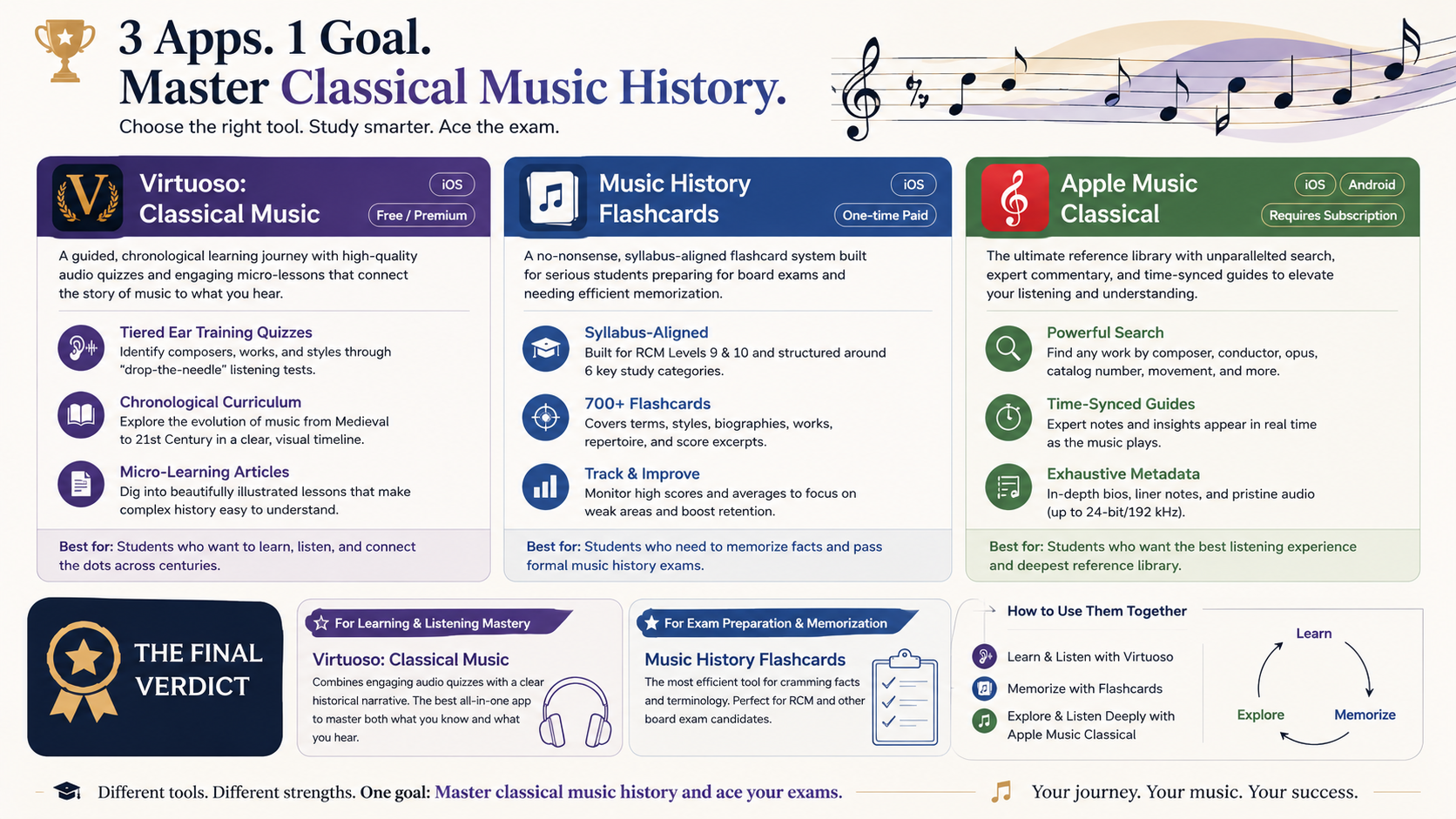
Selecting the ideal study platform depends entirely on the student's specific academic needs and testing format.
If a student requires a rigid, academically vetted tool to cram for formal board certifications—such as the RCM Level 9 or 10—Music History Flashcards is the absolute best choice. It is a no-nonsense, highly efficient memorization engine that targets the exact terminology, repertoires, and biographies required by strict examiners.
However, for university students, undergrads, or dedicated learners who need to master auditory recognition alongside historical facts, Virtuoso: Classical Music is the superior application. By combining high-quality "drop-the-needle" audio quizzes with digestible, chronological articles detailing the shift from Bach to Debussy, it successfully transforms the daunting task of memorizing centuries of musicology into an engaging, comprehensive digital curriculum.