
For many aspiring developers, the biggest obstacle isn't memorizing Python functions or JavaScript keywords. It's understanding the logical process behind programming—variables, control flow, loops, functions, debugging, data structures, and how those concepts connect to solve real problems.
Traditional coding tutorials often fall into one of two traps. Some focus heavily on syntax memorization, while others overwhelm beginners with large projects before foundational thinking skills have developed. The result is familiar: learners can recognize code when they see it but struggle to write it themselves.
To identify the strongest mobile-first coding platforms available in 2026, we spent several weeks testing popular coding apps on both iPhone and Android devices. We focused specifically on apps that teach the complete learning journey—from beginner logic and programming fundamentals to hands-on coding practice in Python, JavaScript, and related languages.
Our evaluation centered on three factors:
How effectively the app teaches programming logic rather than isolated syntax.
Whether users can write and run real code on mobile devices.
How well the curriculum progresses from beginner concepts to practical development skills.
After extensive testing, four apps stood out.
Pricing Model: Free download with optional subscription plans and in-app purchases.
Among all the apps tested, Mimo delivered the most complete end-to-end learning experience for absolute beginners.
What impressed reviewers most was its structured learning path. Instead of presenting Python or JavaScript as a collection of commands, Mimo gradually introduces programming concepts in the same sequence a professional instructor would use: variables, conditions, loops, functions, data structures, and eventually project building. The app also includes a mobile coding environment that allows users to write and execute code directly on their phones.
During commuter testing sessions, reviewers consistently found themselves returning because lessons were short enough to complete in five-minute intervals while still building toward larger concepts.
The strongest feature is not any individual lesson. It's the overall learning roadmap. Mimo feels less like a flashcard app and more like a mobile coding curriculum.
Covers Python, JavaScript, HTML, CSS, SQL, and additional web-development technologies.
Structured progression from beginner concepts to real projects.
Built-in mobile IDE for writing and running code.
Excellent for learners who want a clear path rather than random exercises.
Many advanced features sit behind a subscription paywall.
Strong guidance can sometimes feel restrictive for experienced programmers.
Some users may outgrow the platform once they begin building larger projects.
Pricing Model: Free tier available; Pro subscription available.
If Mimo is the best guided curriculum, SoloLearn is the strongest community-driven learning platform.
What separated SoloLearn during testing was its combination of lessons, coding challenges, quizzes, and community interaction. Learners can study Python, JavaScript, Java, C++, SQL, and numerous other languages while viewing solutions from other users and participating in coding discussions.
During testing, the community aspect consistently accelerated learning. When reviewers became stuck on a programming concept, seeing multiple alternative solutions often clarified the underlying logic faster than rereading a lesson.
The platform covers more than twenty programming languages, making it one of the broadest mobile coding ecosystems currently available.
Supports 20+ programming languages.
Strong coding community and peer feedback system.
Interactive quizzes reinforce logical thinking.
Useful free tier compared with many competitors.
Learning paths can feel less structured than Mimo.
Community-generated content varies in quality.
Some advanced projects require a Pro subscription.
Pricing Model: Free version with optional premium subscription.
Programming Hub takes a different approach from most coding apps. Rather than focusing on one language, it attempts to function as a complete mobile programming library.
During testing, reviewers found it particularly useful for learners who wanted to explore multiple technologies before choosing a specialization. Python, JavaScript, Java, C, C++, web development, and data science topics are all available in one place.
The biggest advantage is breadth. Programming Hub provides a larger catalog of learning material than many competitors, making it ideal for curious learners still deciding whether they prefer web development, software engineering, or data-oriented programming.
Large catalog covering numerous programming languages.
Useful reference material alongside lessons.
Beginner-friendly explanations.
Good option for exploring different programming disciplines.
Less hands-on than the strongest competitors.
Project-based learning is not as polished as Mimo.
Some content feels more like reading than coding.
Pricing Model: Free tier with premium subscription options.
Enki surprised reviewers because it focuses more on programming habits and knowledge retention than traditional tutorials.
Instead of long courses, Enki delivers daily learning sessions covering Python, JavaScript, SQL, computer science fundamentals, and development concepts. The format resembles a coding-focused version of a language-learning platform.
When reviewers used it for several weeks, the app excelled at reinforcing concepts that had already been learned elsewhere. It was particularly effective for strengthening understanding of programming logic, algorithms, and software-development principles.
Enki works best as a companion rather than a standalone coding education platform.
Excellent for daily practice and concept retention.
Covers both programming languages and computer science fundamentals.
Bite-sized lessons fit easily into busy schedules.
Strong focus on long-term knowledge building.
Not ideal as a complete beginner's only learning tool.
Limited project-building opportunities.
Less emphasis on writing large amounts of code.
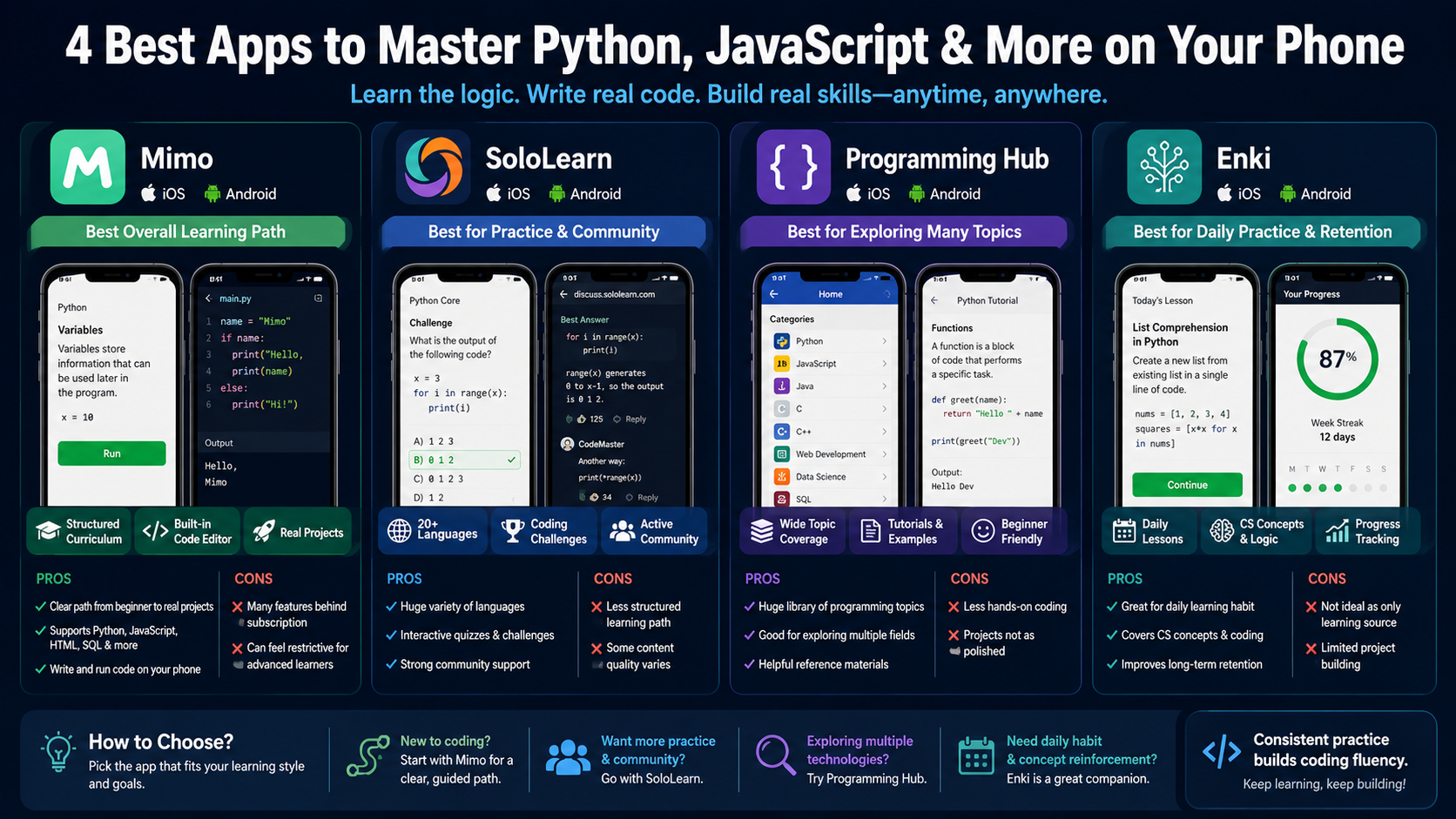
The strongest app depends on what stage of the coding journey a learner is currently facing.
For someone starting from zero and wanting to understand the entire logical process of learning Python, JavaScript, and modern programming, Mimo is the clear winner. Its structured curriculum, integrated coding environment, and project-based progression create the closest experience to a mobile coding bootcamp.
For learners who already know the basics and want more practice, community interaction, and exposure to multiple languages, SoloLearn is the strongest alternative. Its coding challenges and active community make it particularly valuable for developing problem-solving skills.
Meanwhile, Programming Hub is ideal for broad exploration, and Enki serves as an excellent companion tool for reinforcing concepts over the long term.
After weeks of mobile testing, one conclusion became clear: smartphones are no longer just supplemental learning devices. With the right app, they can now guide a learner through nearly the entire journey from writing a first print("Hello World") statement to understanding the logic that powers real software.